Tuesday, April 20, 2010
Understanding the Bible in cartoon
I found this great tool today. You can make a cartoon movie with not much trouble at all. I made this one today on understanding the Bible. It took me about 40 minutes. Enjoy the story.

Saturday, April 10, 2010
Talk on disciplining children
I'm speaking next week to a group of moms about disciplining children. Here's a quick preview of what I think I'll talk about.
- The purpose of discipline (discipleship)
- Keys of God's discipline model (Grace and Truth)
- Tactical discipline
- Plan toward a goal rather than react
- Focus on purpose not facts
- Teach love through obedience not because I say so
- Demonstrate joy not emotionless responsibility
- Guide to life-long meaning not just how to be a good kid
What do you think? Is it practical enough? Will it give young moms more than they already have?
Monday, March 22, 2010
Biblical Family?
My title at the church is Pastor of Life Development. People ask me what that mean all the time. Usually, if I don't figure that they really care what I do specifically, I just tell them that I'm a family pastor. That is sort of true but not really.
Family is a complicated thing. What is a family? Many, or most, evangelical Christians that I know lament the loss of the the traditional family. I might agree that family as our grandparents understood a family to be is going away, but what are we really lamenting? Most people would say that we are loosing the biblical family. But is that true? What did the family look like in the Bible? Was it more like the Duggers or like the Osbounes?
Scot McKnight, professor of New Testament at North Park University, has an interesting post today about a book by the Scottish theologian Stephen Holmes. I would suggest that these men will paint a different picture of the biblical family for us.
In my role of pastor of Life Development, I want it to be more inclusive that just managing the spiritual lives of nuclear families. I hope that Life Development is about challenging all people to a great involvement in mentoring and disciplining the next generation. First, with parents taking a greater part in their children's spiritual development. But just as important is that all people all people--married or not, old or young, with children or without--see that they have an important part to play in the spiritual development of the next generation.
Family is a complicated thing. What is a family? Many, or most, evangelical Christians that I know lament the loss of the the traditional family. I might agree that family as our grandparents understood a family to be is going away, but what are we really lamenting? Most people would say that we are loosing the biblical family. But is that true? What did the family look like in the Bible? Was it more like the Duggers or like the Osbounes?
Scot McKnight, professor of New Testament at North Park University, has an interesting post today about a book by the Scottish theologian Stephen Holmes. I would suggest that these men will paint a different picture of the biblical family for us.
In my role of pastor of Life Development, I want it to be more inclusive that just managing the spiritual lives of nuclear families. I hope that Life Development is about challenging all people to a great involvement in mentoring and disciplining the next generation. First, with parents taking a greater part in their children's spiritual development. But just as important is that all people all people--married or not, old or young, with children or without--see that they have an important part to play in the spiritual development of the next generation.
Monday, March 08, 2010
Never eat zebra and sponsor a Kenyan girl because they count
Compassion is doing a blogger's tour of Kenya right now. I'm glad they are especially since my daughter began to sponsor a Kenyan child a year ago. Her child's name is Margaret. In a recent letter to El, Margaret asks my daughter if she knew what a census was. It seems that the census was taken in her village. Margaret seemed very excited because "she was counted too."
All kids count. We just need to help them to know that. Sponsoring one with Compassion will make that known.
I know you're wondering to read Shawn Grove's post to find out why you should never eat zebra. The pictures are great, too.
All kids count. We just need to help them to know that. Sponsoring one with Compassion will make that known.
I know you're wondering to read Shawn Grove's post to find out why you should never eat zebra. The pictures are great, too.
Tuesday, March 02, 2010
PT: Perfectionism leads to miserable children
Dr. Jim Taylor writes on Pychology Today's blog that children suffer when they feel pressure to be perfect. On the heals of our "All In the Family" series where I talked about ways that parents provoke their children to anger, this article could be helpful for understanding some ways that parents can cause this kind of pressure in the lives of children. Is it possible that you are sending messages, either explicitly or implicitly, that your love is contingent on their success? Here are some ways that parents may to that.
- Rewarding success and punishing failure.
When children succeed, their parents lavish them with love, attention, and gifts. But when they fail, their parents either withdraw their love and become cold and distant, or express strong anger and resentment toward their children. -Jim Taylor
- Model perfectionism by be unduly frustrated at yourself when you fail or overly competitive.
Children see how their parents hate themselves when they're not perfect, so they feel they must be perfect so their parents won't hate them. These parents unwittingly communicate to their children that anything less than perfection won't be tolerated in the family. -Jim Taylor
- Projecting your flaws on your children.
These parents project their flaws onto their children and try to fix those flaws by giving love when their children don't show the flaws and withdrawing love when they do. Unfortunately, instead of creating perfect children and absolving themselves of their own imperfections, they pass them on to their children and stay flawed themselves. -Jim TaylorTaylor goes on to suggest that parents need not be perfect, rather they should strive for excellence. That's a confusing statement, but what he means is work hard to do good as much as possible but allow yourself to fail. I would add that you should let your children fail as well. Bs, Cs, Ds, and even Fs are OK. Big a benchwarmer on a second rate team isn't the worst thing. Not having the whole Bible memory packet complete isn't spiritual suicide. These things don't signal that children are failing at life. They should be a challenge to know where to improve or maybe a signal that the child has a different path in life.
Thursday, January 28, 2010
Hope for young adults: a review of Soul Searching
I have now read several different books on the lives of what Smith and Snell call emergent adults; The First Year Out by Tim Clydesdales, Path to Purpose by William Damon and now Souls in Transition. Now I have just complete Souls in Transition: The Religious and Spiritual Lives of Emerging Adults (Oxford University Press, 2009) by Christian Smith and Patricia Snell. This book focuses most directly on the spiritual health of this age group.
I find Souls in Transition to have a flavor of mixed of concern and hope. Spiritually, 18 to 25-year olds are dropping out of the church in large numbers. We have all suspected this fact and the authors prove it is true with an immense amount of data. As youth transition into adulthood they are finds spiritual question and a desire for a certain lifestyle to be a deterrent from attending the religion of their youth. As a group, there is an across the board shift from more religious commitment to less religious commitment.
On the other hand, the authors have some hope. Like every generation before, I have heard older people of faith proclaim that this younger generation is more lost than ever before. Smith and Snell find that perception is simply not true. At least as far as their study goes back (1972), the current emergent adults are not dropping out any faster than previous generations. In fact, there is a hint that current emergents are actually maintaining faith at a higher rate.
I particularly enjoyed the application of the study. In brief, maintain faith through the emergent adult years is not a matter so much of addressing emergent adults, but a healthier treatment of the teens. Smith and Snell describe that as a process of socializing that first starts in the home but is echoed in mentors within the church. Older adults of faith, both parents and church-folk, need to avoid the pitfall of encouraging youth to push away from them. The myth says that youth no longer want adults to participate in their lives. Instead, the authors’ data show that youth want adult contact, but they need it on new terms. Youth that receive a good amount of attention from adults of faith are more likely to maintain their faith into adulthood.
I find Souls in Transition to have a flavor of mixed of concern and hope. Spiritually, 18 to 25-year olds are dropping out of the church in large numbers. We have all suspected this fact and the authors prove it is true with an immense amount of data. As youth transition into adulthood they are finds spiritual question and a desire for a certain lifestyle to be a deterrent from attending the religion of their youth. As a group, there is an across the board shift from more religious commitment to less religious commitment.
On the other hand, the authors have some hope. Like every generation before, I have heard older people of faith proclaim that this younger generation is more lost than ever before. Smith and Snell find that perception is simply not true. At least as far as their study goes back (1972), the current emergent adults are not dropping out any faster than previous generations. In fact, there is a hint that current emergents are actually maintaining faith at a higher rate.
I particularly enjoyed the application of the study. In brief, maintain faith through the emergent adult years is not a matter so much of addressing emergent adults, but a healthier treatment of the teens. Smith and Snell describe that as a process of socializing that first starts in the home but is echoed in mentors within the church. Older adults of faith, both parents and church-folk, need to avoid the pitfall of encouraging youth to push away from them. The myth says that youth no longer want adults to participate in their lives. Instead, the authors’ data show that youth want adult contact, but they need it on new terms. Youth that receive a good amount of attention from adults of faith are more likely to maintain their faith into adulthood.
Monday, January 25, 2010
I long for thunder
I long for thunder
I long for thunder
Thunder rolling in
The kind I can hear for an hour before the first raindrops fall
I long for thunder
Thunder that when it arrives the house shakes
The dog paces
And I think this is what the end will be like
I long for thunder
The flashing of light
The count down before the CRASH
The search for candles to replace electric lights
I long for thunder
It brings me back to my childhood
To my father telling me "it's all OK"
The comfort I have in knowing
It's much bigger than me
I long for thunder
But alass. It is winter and the rain that comes
Only brings wind, icey pings, and the sound of the heater kicking up
I may long for thunder
But today I'll face the cold rain
Knowing that I'm fortunate enought to have a warm house for retreat
And it is still bigger than me
Steve Johnson
Saturday, January 09, 2010
The uncomfortable Blue Parakeet can make you think
Recently, a good friend complained to me that a particular Bible discussion didn't help to clarify the particular issue in his mind. He said, "I walked a way less sure and more confused." My response was "good."
Over the recent years I have become more comfortable with the idea that God is too big for us to know with clarity. Without a doubt, we are to strive each day to know him better than the last day. We are to study his word (the Bible), listen to expert comentaries, and discuss it in faithful groups of Christians. These are important steps for the follower of Christ and will facilitate spiritual growth.

We cannot expect that Christian growth means that we are less confused, that we know God more perfectly, or that our study will raise much of anything but more questions. Karl Barth (pronounced bart), a Swiss, Neo-orthodox theologian who valiantly battle liberal theology in the early to mid-1900s, called this dialectical theology because he believed that too much of God was paradoxical and unknowable to the human. Barth's point was that the best answer to a theological question was the next best question.
This brings me to my book review on Scot McKnight's The Blue Parakeet (Zondervan, 2008, 240 pages). (I provided this link for your convenience should you like to read the book. I read the Kindle version.) McKnight is a thoughtful, seasoned Bible scholar who teaches at North Park University in Chicago. In The Blue Parakeet, McKight examines how we should read the Bible, particularly the difficult passages. I'll let you read the book to discover why it is named so.
McKnight, by his own reasoning, is an evangelical scholar. There are many with a more narrow interpretation of evangelical who wouldn't agree, because many evangelicals will only identify with others who subscribe to specific set of doctrine. This doctrine is often narrow in interpretation and broad in scope.
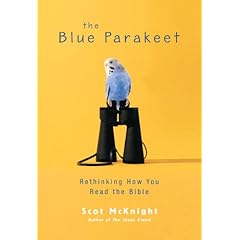
One point that many evangelicals will struggle with the Blue Parakeet and McKnight, is that he is in many way post-modern. He makes a strong argument that the Bible must be read as a story (not a fiction story) and applied according to the context of the reader. He argues that too many want to read the Bible as a list of laws, morsels of blessings, an psychological inkblot, a puzzle, or examples of Maestros. I will let McKnight explain those.
McKnight, on the other hand, believe the Bible is God's story from begining to end, with each book being the author's telling of the story at a particular time to a particular people. The challenge then is to read the Bible with an understanding of that time and people, and learn what that means to today and to the people you live among. This is not easy. It is more work than the other ways we can read the Bible. It also means that two people in two different places may draw different interpretations, particularly with respect to a passage's application.
At this point, I'm sure that many of my Christian friends are getting uncomfortable. That is alright. I was too, and I think that it is that discomfort that drove me to read the rest of the Blue Parakeet with an open, but discerning mind. In the end, discernment is the crux of McKnight's book. Everything in the Bible must be discerned with the Holy Spirit and nothing is settled.
This post is already too long, but there is more I would like to say about these matter. I hope to do so in other posts. Let me just conclude by saying that as I read the Blue Parakeet, I felt uncomfortable. I still do not agree with every point he makes, but I can tell you that I also began asking a lot more questions about my God, myself and my understanding of what it means to know God. I was driven deeper into my Bible, and, while I developed more questions, I believe that the depth of my questions is growing. I believe this book has helped me to grow as a believer, too.
Over the recent years I have become more comfortable with the idea that God is too big for us to know with clarity. Without a doubt, we are to strive each day to know him better than the last day. We are to study his word (the Bible), listen to expert comentaries, and discuss it in faithful groups of Christians. These are important steps for the follower of Christ and will facilitate spiritual growth.
This brings me to my book review on Scot McKnight's The Blue Parakeet (Zondervan, 2008, 240 pages). (I provided this link for your convenience should you like to read the book. I read the Kindle version.) McKnight is a thoughtful, seasoned Bible scholar who teaches at North Park University in Chicago. In The Blue Parakeet, McKight examines how we should read the Bible, particularly the difficult passages. I'll let you read the book to discover why it is named so.
McKnight, by his own reasoning, is an evangelical scholar. There are many with a more narrow interpretation of evangelical who wouldn't agree, because many evangelicals will only identify with others who subscribe to specific set of doctrine. This doctrine is often narrow in interpretation and broad in scope.
McKnight, on the other hand, believe the Bible is God's story from begining to end, with each book being the author's telling of the story at a particular time to a particular people. The challenge then is to read the Bible with an understanding of that time and people, and learn what that means to today and to the people you live among. This is not easy. It is more work than the other ways we can read the Bible. It also means that two people in two different places may draw different interpretations, particularly with respect to a passage's application.
At this point, I'm sure that many of my Christian friends are getting uncomfortable. That is alright. I was too, and I think that it is that discomfort that drove me to read the rest of the Blue Parakeet with an open, but discerning mind. In the end, discernment is the crux of McKnight's book. Everything in the Bible must be discerned with the Holy Spirit and nothing is settled.
This post is already too long, but there is more I would like to say about these matter. I hope to do so in other posts. Let me just conclude by saying that as I read the Blue Parakeet, I felt uncomfortable. I still do not agree with every point he makes, but I can tell you that I also began asking a lot more questions about my God, myself and my understanding of what it means to know God. I was driven deeper into my Bible, and, while I developed more questions, I believe that the depth of my questions is growing. I believe this book has helped me to grow as a believer, too.
Monday, December 21, 2009
How to improve your adolescent's grades by one letter in just 15 minutes
Give them more sleep.
Ashley Merryman demonstrates that more sleep will improve your adolescent's grades, make them happier people and make them safer drivers. So when are parents going to start pushing school boards to adjust the school calendar? Maybe it should be a priority.
Ashley Merryman demonstrates that more sleep will improve your adolescent's grades, make them happier people and make them safer drivers. So when are parents going to start pushing school boards to adjust the school calendar? Maybe it should be a priority.
Tuesday, December 15, 2009
Myth of Christmas: Immaculate Conception
I believe in the birth of Jesus as it is told in the Bible. I believe that it was miraculous and that he was born of a virgin. The doctrine of the Immaculate Conception, however, is pure myth. Many people mistake these two doctrines. I just heard a well-educated and prominant Christian author/speaker make this mistake.
The Immaculate Conception doesn't refer to how Jesus came onto this earth. It is about Mary's birth. Particularly, it is the belief that Mary came into this world without original sin, or without a sin nature for that matter. This is not a biblically defensible doctrine.
As you think about the truths of the coming of our Savior, consider the misconceptions that are often spread this time of year. Can you think of any others?
The Immaculate Conception doesn't refer to how Jesus came onto this earth. It is about Mary's birth. Particularly, it is the belief that Mary came into this world without original sin, or without a sin nature for that matter. This is not a biblically defensible doctrine.
As you think about the truths of the coming of our Savior, consider the misconceptions that are often spread this time of year. Can you think of any others?
Sunday, December 13, 2009
Is the Christian Religion a Myth. Review of Greg Boyd's book
Greg Boyd isn't the kind of pastor who says the things you'd expect pastors to say. No, he calls them as he sees them and The Myth of a Christian Religion: Loosing Your Religion maintains his MO. Of course, if you pick this book up knowing the title and didn't figure that this would be a different look at our faith, you didn't read the title.
Boyd's thesis is that Jesus didn't come to start a religion, but he came to start a revolutions. (Again, plain in the title.) A religion is too institutional, too people centered for what Jesus came to do. He didn't come to create more ritual. He came to be counter-cultural.
The revolution is against so many bad habits that people fall into. Interestingly, they are the same bad habits that many/most American Christians have: Idolatry of stuff; Judgmentalism; Individualism; Gaining power through military action. He adds issues like sex and secularism. By secularism, in contrast to so many Christians, he isn't attacking the secular world for being secular. Rather he is frustrated with Christians who live dualistic lives of sacred and secular.
Boyd's voice is important for the American Church to hear. We need more people pointing the misconceived values that have become standard in our churches and personal practices. He makes some bold statements. Bold statements will make some people uncomfortable, and he's certainly not perfect in his analysis, but this discomfort may be the Spirit prompting the reader to reconsider things that we often take as true without recent contemplation.
Boyd's thesis is that Jesus didn't come to start a religion, but he came to start a revolutions. (Again, plain in the title.) A religion is too institutional, too people centered for what Jesus came to do. He didn't come to create more ritual. He came to be counter-cultural.
The revolution is against so many bad habits that people fall into. Interestingly, they are the same bad habits that many/most American Christians have: Idolatry of stuff; Judgmentalism; Individualism; Gaining power through military action. He adds issues like sex and secularism. By secularism, in contrast to so many Christians, he isn't attacking the secular world for being secular. Rather he is frustrated with Christians who live dualistic lives of sacred and secular.
Boyd's voice is important for the American Church to hear. We need more people pointing the misconceived values that have become standard in our churches and personal practices. He makes some bold statements. Bold statements will make some people uncomfortable, and he's certainly not perfect in his analysis, but this discomfort may be the Spirit prompting the reader to reconsider things that we often take as true without recent contemplation.
Wednesday, December 09, 2009
Review of The Divine Commodity by Skye Jethani
The Divine Commodity by Leadership Journal editor Skye Jethani (Zondervan: 2009) is a green vegetable book, not a dessert book. It doesn't taste good, but it is good for you. You won't be happy that you read it, but you'll be better off. Skye Jethani will challenge your comfortable way of doing church. He will push you to consider your faith more than your religious out workings. He destroyed any chance I had of enjoying Christmas like in the feel-good way it has always been. Jethani does all this using a wonderful comparison of the church and van Gogh paintings. It's a creative, well-written book, and as such a easy book to read. It's not an easy book to consume.
Saturday, December 05, 2009
Should we celebrate Advent (or Christmas)
Note: I originally posted this as a response to a blog by Mark Roberts. He wrote on the question Is Advent Biblical? I would suggest that you read his post. He writes very well. I decided to re-post my response on my blog because I think it explains well why I'm not all keen on this season, Advent as well as Christmas.
Whether Advent is biblical, is not my concern. Certainly, it is based in the very biblical goals that you ask us to consider. All things, including Advent, and for that matter Christmas, are permissible.
However, I wonder how beneficial it is for the church to celebrate this season. I include Christmas as we currently celebrate it, particularly by demanding that the money takers take our money in the most religious was.
This whole season is a distraction. I don't know of a single family in my church that will spend more time focused on the elements of Advent that you talk about as good, instead use the Advent season to focus on material things. Celebrating Advent as a church encourages Open Season for materialism.
I say this as one who as a pastor to children. There is almost no way to spend Advent focused on Jesus. Advent, by its nature, focuses on the minor things of the scriptures, not the coming of the Savior. Sure Jesus is the consistent thread of the Advent season, but he because a minor player as we spend the month focus on Mary and donkeys, Joseph, Wise Men and Angels. Camels usually take a bigger role that Jesus. Even Jesus is caricature during this season. We talk a lot about a baby, but our link to the Jesus that died for our sins is usually lost in making Jesus God's gift to us. It is true that Jesus is a gift to us, but the way it plays out in the way we do Advent and Christmas is that Jesus is just another gift like the many we will rush out to buy after our worship service.
Sure Advent is permissible. There are many noble reasons for celebrating the season. Unfortunately, Advent and Christmas are not beneficial. Sure, you can name the half dozen people you know that turned to Christ in this season, but consider how many turn away from him and turn toward minor issues of faith or toward worldly matters.
Whether Advent is biblical, is not my concern. Certainly, it is based in the very biblical goals that you ask us to consider. All things, including Advent, and for that matter Christmas, are permissible.
However, I wonder how beneficial it is for the church to celebrate this season. I include Christmas as we currently celebrate it, particularly by demanding that the money takers take our money in the most religious was.
This whole season is a distraction. I don't know of a single family in my church that will spend more time focused on the elements of Advent that you talk about as good, instead use the Advent season to focus on material things. Celebrating Advent as a church encourages Open Season for materialism.
I say this as one who as a pastor to children. There is almost no way to spend Advent focused on Jesus. Advent, by its nature, focuses on the minor things of the scriptures, not the coming of the Savior. Sure Jesus is the consistent thread of the Advent season, but he because a minor player as we spend the month focus on Mary and donkeys, Joseph, Wise Men and Angels. Camels usually take a bigger role that Jesus. Even Jesus is caricature during this season. We talk a lot about a baby, but our link to the Jesus that died for our sins is usually lost in making Jesus God's gift to us. It is true that Jesus is a gift to us, but the way it plays out in the way we do Advent and Christmas is that Jesus is just another gift like the many we will rush out to buy after our worship service.
Sure Advent is permissible. There are many noble reasons for celebrating the season. Unfortunately, Advent and Christmas are not beneficial. Sure, you can name the half dozen people you know that turned to Christ in this season, but consider how many turn away from him and turn toward minor issues of faith or toward worldly matters.
Thursday, December 03, 2009
Are you making your kids want to live with you forever?
It may be that your lifestyle is stunting the maturity of your children in such a way that they won't have the drive to move out of your home. A recent article in Psychology Today says that the trend for children to live with their parents later is attributable to our affluent lifestyle. Stephen Mason writes
It means that the tide of hormones that hits pubescent kids, the tide that causes them to want to fly from the nest provided by their parents, has been greatly attenuated by the economics of America in the 21st Century. The rights of passage and the periods of apprenticeship that have always been a part of the teen years and of growing up, have been largely replaced by an additional decade of utter dependence.
Tuesday, December 01, 2009
With jetlag, returning home brings contemplation
We're home.
We were all awake by 5am this morning.
Writing might be interesting because my mind is already shutting down for the day.
But I have a lot to think about after our wonderful trip to Italy.
First, pray for these things:
We were all awake by 5am this morning.
Writing might be interesting because my mind is already shutting down for the day.
But I have a lot to think about after our wonderful trip to Italy.
First, pray for these things:
- Our family has a busy first week back. Pray for strength, focus and alertness as we get back on schedule.
- Pray for Tim and Jacki as the weakening dollar makes funds tighter.
- Pray for Il Faro in Naples, the Bible School students and Il Faro in Turin as they contemplate the message I brought about youth and family ministry.
- Pray for Richard, a man I met on the plane from Rome. We had a deep discussion that open a door to the Gospel. He never thought that the Christian religion was anything other than the judgment he sees in the News. Pray that he will be bombarded with others who share that Christ's message is one of love.
- How can we at Grace Point learn from the mentoring and youth in ministry in Naples?
- How can I be more active in discipling young believers?
- If we lived in a house that only had heat on for one short period over 10 days, can we cut back our energy use in our home?
- After spending 10 days contemplating the Italian culture, do I really know the Bucks County USA culture?
- Is it OK for me to wear the scarf with a heart on it in the US just because I saw a couple men in Italy wearing it?
Friday, November 27, 2009
Praying for Italy
Dear friends,
We continue to have a wonderful visit here in Italy. Yesterday, for Thanksgiving, we ate Kebabs. Not exactly a traditional, American Thanksgiving meal, but we were standing on the streets of Rome while we ate.
Rome was beautiful and amazing. Our tour was more of a overview of the sites in the city, but it was meaningful none the less. Visiting the Basilica of St. Peter was meaningful as we saw statue after statue of one Saint or the other, only to find the statue of Jesus tucked in the corner. It reminded me of how easy it can be to tuck Jesus into the corner of my ministry lifting up my own work or the work of people I admire. I can easily get distracted with all the other things that I want to honor. But Jesus is the one most deserving on honor.
Please continue to pray for us. The next three nights I will be speaking to different groups. Tonight and Sunday to church leaders from many local church. Saturday night, I'll speak to the youth of many of those churches. Pray for great boldness. The culture needs the message that I bring about all people doing their part for the Kingdom. They have a Pope/Godfather way of looking at ministry here, but they are one the verge of overcoming it. Pray also for clarity in my words and for Tim as he translates.
Please take a moment to catch up with us at my blog and Stef blog. We've both updated since Tuesday.
God bless you all. We miss you.
Steve (for the whole family)
We continue to have a wonderful visit here in Italy. Yesterday, for Thanksgiving, we ate Kebabs. Not exactly a traditional, American Thanksgiving meal, but we were standing on the streets of Rome while we ate.
Rome was beautiful and amazing. Our tour was more of a overview of the sites in the city, but it was meaningful none the less. Visiting the Basilica of St. Peter was meaningful as we saw statue after statue of one Saint or the other, only to find the statue of Jesus tucked in the corner. It reminded me of how easy it can be to tuck Jesus into the corner of my ministry lifting up my own work or the work of people I admire. I can easily get distracted with all the other things that I want to honor. But Jesus is the one most deserving on honor.
Please continue to pray for us. The next three nights I will be speaking to different groups. Tonight and Sunday to church leaders from many local church. Saturday night, I'll speak to the youth of many of those churches. Pray for great boldness. The culture needs the message that I bring about all people doing their part for the Kingdom. They have a Pope/Godfather way of looking at ministry here, but they are one the verge of overcoming it. Pray also for clarity in my words and for Tim as he translates.
Please take a moment to catch up with us at my blog and Stef blog. We've both updated since Tuesday.
God bless you all. We miss you.
Steve (for the whole family)
Developing a light in the darkness
Once upon the time, Rome was the headquarters of the church in the Western world. While it still is the center of Catholicism, the message of Christ is, at best, marginalized in this culture. This is a postmodern nation. The Catholic Church is a part of the culture, but that does not equate to faith in Christ. Italy is by most measure a dark world.
The good news is that Christ has not abandoned Italy. He loves these people and is working to bring salvation to them. I am excited about the work that God is doing through a humble church called Il Faro. Il Faro is the project for two American missionaries, Tim Monahan and Tim Faulkner. The leadership doesn't stop with the missionaries. There are also 3 volunteer Italian pastors leading this team with a plan to turn the senior leadership over to a well qualified man named Luigi.
What amazes me about Il Faro is that they represent 3 clear cultural groups (Italian, American, African), yet they are in all ways (excluding language) unified in purpose and in worship. When I walked into the church service, I witnessed a beautiful mix of Americans (predominately service men, women and families) and Neapolitan Italians with a few African immigrants, all in one room worshiping together. Music and style tastes are put aside. All songs are sung in a blend of English and Italian, one line in one language repeated in the other.
It's beautiful to hear someone pray to our Lord in an unknown language. It always reminds me that our God is greater than any culture. The leadership team at Il Faro knows this fact and have used the greatness of God and his singular mission of reaching the world as a centerpiece to draw the church together. The members all know this common mission. The leaders constantly challenge them to live the mission. As a result, they are, in all reality, one church.
Speaking with Tim Faulkner this morning, he reminds me that this is a result, a direct result, of the work of Grace Point. Through our support, our prayer and much wise counsel, Grace Point has helped to unify this church. The two Tim's and the other pastors are all very different in their mix of personalities and gifts, and that mix is a benefit for this church.
I have visited other churches this week. They are all different and all being used one way or another for delivering God's Word to the Italian people, but none as effectively as Il Faro in Naples. I hope that the people of Grace Point know the value of their work. It isn't in creating a big project or by counting the number of professions of faith that come from a outreach event. The value of this church and our participation in it is our long-term commitment to strong leadership, wise counsel and prayer.
Il Faro is a light to Naples. Grace Point is a part of providing that light to the darkness of this community. God is working through all of us.
Praise God. And Happy Thanksgiving.
The good news is that Christ has not abandoned Italy. He loves these people and is working to bring salvation to them. I am excited about the work that God is doing through a humble church called Il Faro. Il Faro is the project for two American missionaries, Tim Monahan and Tim Faulkner. The leadership doesn't stop with the missionaries. There are also 3 volunteer Italian pastors leading this team with a plan to turn the senior leadership over to a well qualified man named Luigi.
What amazes me about Il Faro is that they represent 3 clear cultural groups (Italian, American, African), yet they are in all ways (excluding language) unified in purpose and in worship. When I walked into the church service, I witnessed a beautiful mix of Americans (predominately service men, women and families) and Neapolitan Italians with a few African immigrants, all in one room worshiping together. Music and style tastes are put aside. All songs are sung in a blend of English and Italian, one line in one language repeated in the other.
It's beautiful to hear someone pray to our Lord in an unknown language. It always reminds me that our God is greater than any culture. The leadership team at Il Faro knows this fact and have used the greatness of God and his singular mission of reaching the world as a centerpiece to draw the church together. The members all know this common mission. The leaders constantly challenge them to live the mission. As a result, they are, in all reality, one church.
Speaking with Tim Faulkner this morning, he reminds me that this is a result, a direct result, of the work of Grace Point. Through our support, our prayer and much wise counsel, Grace Point has helped to unify this church. The two Tim's and the other pastors are all very different in their mix of personalities and gifts, and that mix is a benefit for this church.
I have visited other churches this week. They are all different and all being used one way or another for delivering God's Word to the Italian people, but none as effectively as Il Faro in Naples. I hope that the people of Grace Point know the value of their work. It isn't in creating a big project or by counting the number of professions of faith that come from a outreach event. The value of this church and our participation in it is our long-term commitment to strong leadership, wise counsel and prayer.
Il Faro is a light to Naples. Grace Point is a part of providing that light to the darkness of this community. God is working through all of us.
Praise God. And Happy Thanksgiving.
Tuesday, November 24, 2009
Update for our friends
Dear praying friends,
Thanks for your support. Some of you were not getting our updates. Here's a quick note to remind you to check out our American Thanksgiving in Italy Facebook page and my blog http://deetsjohn.blogspot.com.
We'll do more later, but our internet service is spotty, so we do what we can.
Please pray for Jacki who is still struggling with pain.
God bless you all,
Steve
Thanks for your support. Some of you were not getting our updates. Here's a quick note to remind you to check out our American Thanksgiving in Italy Facebook page and my blog http://deetsjohn.blogspot.com.
We'll do more later, but our internet service is spotty, so we do what we can.
Please pray for Jacki who is still struggling with pain.
God bless you all,
Steve
A quick story about how God works
At the Naples (Italy) soccer game on Sunday, we sat down next to an Italian man who hear us speaking in English. He was excited to practice his English on us and did a great job. He shared a bit about the game and the Naples team in particular. It's not unusual for Italians to want to practice English with an American.
The unusual thing about this story is that while Stefanie and I talked to this man, an young man the row behind him overheard us. He said to Stefanie, "Excuse me. Are you American? I overheard you talking."
It turns out this young man, Ryan, is a 17-year-old exchange student from North or Scranton, a town only minutes away from Tim's parents. What are the chances of us running into each other in a city of millions and a stadium of 70,000?
We hope to have Ryan to our Thanksgiving dinner later this week. Pray that this will be another door of ministry for the Faulkners and the Johnson.
The unusual thing about this story is that while Stefanie and I talked to this man, an young man the row behind him overheard us. He said to Stefanie, "Excuse me. Are you American? I overheard you talking."
It turns out this young man, Ryan, is a 17-year-old exchange student from North or Scranton, a town only minutes away from Tim's parents. What are the chances of us running into each other in a city of millions and a stadium of 70,000?
We hope to have Ryan to our Thanksgiving dinner later this week. Pray that this will be another door of ministry for the Faulkners and the Johnson.
Monday, November 23, 2009
One weekend down
Dear friends,
Today is Monday and we made it through a crazy weekend. Crazy but wonderful. We are reunited in Naples. Today is a bit of a down day for us as Tim and I have time to work at the church while the ladies are at the Faulkner home doing schoolwork and cleaning up a bit. Yesterday was a good day of worship at Il Faro. God is doing great things here.
Please continue to pray for us. I'm finding myself a little tired but still very excited about our work here. The people are a delight.
Pray also for:
Praise God for:
Steve
Today is Monday and we made it through a crazy weekend. Crazy but wonderful. We are reunited in Naples. Today is a bit of a down day for us as Tim and I have time to work at the church while the ladies are at the Faulkner home doing schoolwork and cleaning up a bit. Yesterday was a good day of worship at Il Faro. God is doing great things here.
Please continue to pray for us. I'm finding myself a little tired but still very excited about our work here. The people are a delight.
Pray also for:
- Giacoma, a bible school student, who is in the hospital after some sort of negative food reaction. Tim and I will be meeting her at the hospital and connecting her with a ride back to the school in Rome. Rome is about 2 hours from Naples.
- Pray for Jacki. She has been in a good amount of pain since we've been here. She will have some test today. Pray for healing.
- Strength and rest for our family. It was a busy weekend and we are tired. At least we slept well last night.
Praise God for:
- Strength so far.
- A wonderful worship time in the Faulkners bi-cultural church (Il Faro). It is amazing to hear people pray in multiple languages reminding us that God is omni-cultural.
- Insight into a well-led, on-fire church, Il Faro. They are few and far between in Italy.
Steve
Subscribe to:
Posts (Atom)